



Drug testing in construction plays a key role in keeping job sites safe, projects on schedule, and your company within legal limits. If you're managing teams around cranes, scaffolds, or hazardous setups, you already know that even a brief impairment can lead to major incidents.
The pressure on HR and compliance is growing. Between federal rules tightening their grip and constant shifts in state marijuana laws, it's tough to know what's required versus what's simply a good idea. This guide breaks that down.
We'll cover required drug tests, when to test, how to handle marijuana policy, and what federal contractors cannot ignore. If you're juggling onboarding and site clearances every week, KRESS is here to help make drug testing predictable, compliant, and faster.
Why Do We Need Drug Testing?
Construction remains one of the highest-risk fields for workplace injury in the United States. Falls, struck-by incidents, electrocutions, and caught-in or caught-between events make up OSHA's "Fatal Four," and together they account for more than half of construction worker deaths each year, according to OSHA's commonly used construction safety statistics. When heavy machinery and elevated work are involved, the danger is already high. Add substance use, and it multiplies.
Consider what impairment does on a job site:
- Even temporary impairment leads to poor judgment and slow reaction time.
- A mistimed forklift move or a misstep on scaffolding can cause severe harm.
- Drug-testing programs have been linked to meaningfully fewer injuries: an older construction-industry study by Gerber and Yacoubian reported a roughly 51 percent drop in incident rates within two years of adopting testing, though that research focused on small firms and is now more than two decades old, so treat it as supporting context rather than a guarantee. You can read the study record on PubMed.
That's why drug testing isn't just a preventive step; it's an expected part of risk management, much like insurance or licensing. If you want a closer look at how screening pays off before a hire even starts, KRESS explains the benefits of pre-employment drug testing.
Key Testing Methods Used in Construction
Choosing the right test method depends on job risk level, regulatory status, and the timing of the test. Here's a breakdown of commonly used methods.
Urine Testing (DOT-Compliant, Most Common)
- Required for DOT-regulated employees
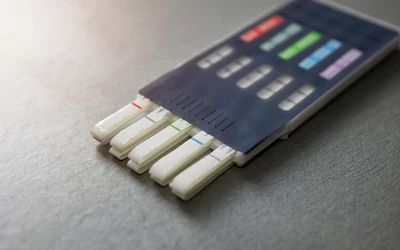
- Detects recent drug use, usually 1 to 3 days back, though windows vary by dose and individual
- Must be analyzed by SAMHSA-certified labs per DOT rules
- Used widely across all types of construction roles
Urine testing remains the standard because it aligns with 49 CFR Part 40 requirements.
Hair Follicle Testing
- Detects drug use over a longer window, often cited as up to about 90 days
- Useful for identifying patterns of misuse
- Not allowed for DOT-covered roles
- Common for long-term, high-risk hires that fall outside federal regulation
Breath Alcohol Testing
- Used when alcohol impairment is suspected
- Delivers onsite results instantly
- Approved for DOT post-accident and reasonable-suspicion testing
- Under DOT rules, a breath alcohol concentration of 0.02 or higher removes a safety-sensitive employee from duty, and 0.04 or higher is a violation
Breath testing is practical for incidents or concerns in the moment, and it isn't tied to remote lab verification the way urine testing is for controlled substances. To set up a program that pairs the right methods with the right roles, see KRESS workplace drug testing services.
When Should Employers Test for Drugs?
Timing matters. Testing isn't a one-time activity; it's tied to company policy, incident response, and compliance frameworks. Here's how the common testing triggers line up.
| Test type | When it happens | Why it matters |
|---|---|---|
| Pre-employment | Before a candidate starts work | Confirms new hires are clear before entering the site |
| Random | At unannounced intervals during employment | Reinforces a drug-free workplace and meets federal requirements; PHMSA currently sets the random rate at 50 percent for covered pipeline roles |
| Post-accident | After an incident or event | Helps determine whether impairment played a role |
| Reasonable suspicion | When documented behavior raises concern | Lets supervisors act before a risk grows |
For roles that need ongoing oversight rather than a single snapshot, KRESS also offers continuous monitoring so compliance gaps don't surface months later.
What's in a Standard Construction Drug Test?
A typical five-panel urine test screens for the same five drug classes the DOT requires under 49 CFR Part 40:
- THC (marijuana)
- Cocaine
- Opiates (including heroin, morphine, and codeine)
- Amphetamines (including methamphetamine)
- PCP
Depending on job risk or insurance guidelines, employers sometimes add substances such as:
- Benzodiazepines (Valium and Xanax)
- Fentanyl
- Methadone
- Barbiturates
For federally regulated roles, point-of-collection tests aren't accepted; results must be confirmed through certified labs and reviewed by a Medical Review Officer.
Key Rules for Federally Regulated Construction Work
DOT Testing Requirements at a Glance
If your employees operate under DOT guidelines, testing isn't optional. Employers must:
- Follow 49 CFR Part 40
- Use only SAMHSA-certified labs
- Maintain strict chain-of-custody procedures
- Prohibit THC use even where recreational or medical marijuana is legal, consistent with the DOT marijuana notice
PHMSA Update: The Random Testing Rate Stays at 50 Percent
Effective January 1, 2025, PHMSA raised the minimum random drug testing rate for covered pipeline employees from 25 percent to 50 percent. For calendar year 2026, the agency has kept that rate at 50 percent, because the industry's reported positive rate again exceeded 1 percent. The requirement applies to operators and contractors covered under 49 CFR Part 199, including pipeline construction crews tied to gas, hazardous liquid, and related facilities. You can review the determination in the Federal Register notice for the 2026 rate.
If your job site even touches pipeline transportation, make sure your drug testing program reflects this rate. For a deeper walkthrough of how these rules play out in adjacent energy work, see the KRESS guide to oil and gas drug testing and HR compliance.
Balancing Federal, State, and Marijuana Laws
This is where things get harder. Employers often ask: is marijuana allowed if it's legal in the state? The short answer is no, not under DOT, and not if it creates safety risks at work.
Here's what to know:
- Federal law still classifies marijuana as a controlled substance.
- DOT-regulated roles, including any CDL, heavy equipment, or pipeline work, prohibit THC use entirely.
- Even for non-DOT employees, jobsite impairment can be grounds for discipline or dismissal.
Your drug-free workplace policy should reflect these differences. With drug use rising across many sectors, KRESS has written about why testing matters more than ever.
Two-State Example
- California protects certain off-duty cannabis use under Government Code 12954, but that statute expressly exempts employees in the building and construction trades, so construction employers in California can keep testing for marijuana.
- Texas does not allow recreational use and permits employers to enforce zero-tolerance policies.
In both states, employers can prohibit on-duty use or impairment, and in both, construction employers can act on a positive marijuana result. The main difference is paperwork and policy language rather than your underlying authority to test crews. Without a clear written policy, though, you're exposed.
Build a Safe Response for THC
- Clarify pre-hire testing policies and which substances are disqualifying
- Include impairment protocols in job descriptions and handbooks
- Train managers on identifying impairment
A consistent, written approach protects both workers and the company. The hiring decision always stays with you as the employer; KRESS supplies the data and the workflow so you can act on it with confidence.
How KRESS Supports Construction Employers
We help HR and compliance teams build a drug testing program that works without slowing projects down:
- Drug testing options for both DOT and non-DOT roles
- Secure, FCRA-compliant reports delivered through our client portal
- Support for customizable drug-free workplace policies
- Live advisor access, not an AI chatbot or a ticket queue
- Alerts on compliance updates, including PHMSA rule changes and court shifts on state-law protections
You get lab-certified results quickly, without chasing paperwork or wondering what came back flagged. To see the full picture, explore KRESS background checks for construction companies.
Frequently Asked Questions
What type of drug test is typically used in construction jobs?
Five-panel urine tests are the most common. They are required for DOT-regulated employees and strongly recommended for safety-sensitive roles.
Are construction companies legally required to drug test?
Companies working on federal contracts or those with DOT-regulated employees are required to test. Private employers may set testing policies based on jobsite needs.
What happens if a worker tests positive?
Your policy should outline the next steps. Some companies remove the worker from safety roles, while others offer a second-chance policy pending evaluation. For DOT roles, workers must complete a return-to-duty process overseen by a qualified substance abuse professional.
Is marijuana allowed if it's legal in my state?
Not in DOT-regulated roles, and not while working or impaired onsite. Some states protect certain off-duty use, but those protections often carve out construction and safety-sensitive work, and you can still ban onsite use.
How do I know if PHMSA random testing applies to us?
If your work relates to natural gas, hazardous liquid pipelines, or storage facilities under DOT jurisdiction, PHMSA rules apply. Those workers should sit in a separate random selection pool.
Compliance Without the Chaos
Drug screening doesn't need to hold up your job site. KRESS delivers results quickly and helps your hiring and safety teams stay compliant, from the first pre-employment screen through PHMSA-covered random pools.
If you're building or refreshing your drug testing policy, the next step is simple. Get a quote for construction drug testing and you'll receive clear pricing and next steps within one business day. A few minutes now can save you a failed inspection, a fine, or an unsafe site later.