








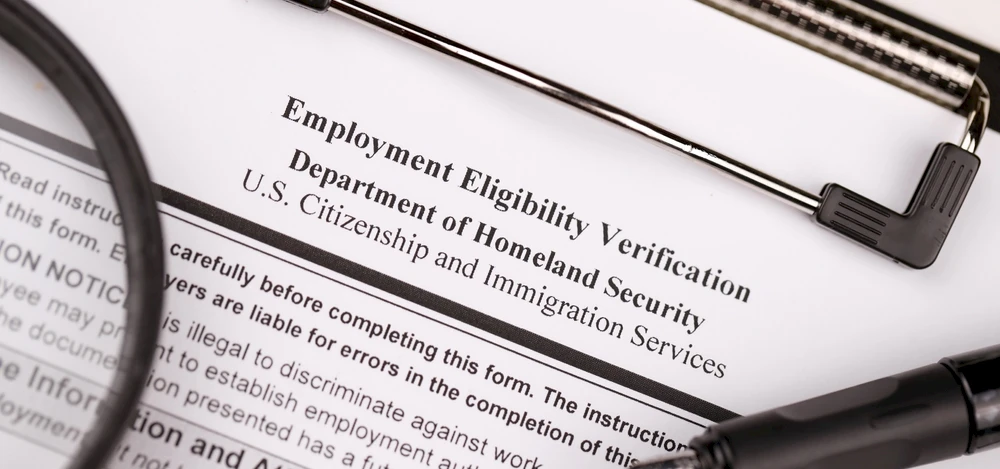
A column for HR professionals who thought they had this one covered.
In 1997, the Clinton administration issued a piece of internal guidance that would quietly become one of the most important documents in HR compliance. It was called the Virtue Memorandum, and for nearly three decades, it did something remarkably simple: it told ICE inspectors to give employers a chance to fix their Form I-9 mistakes before fining them.
Missing a middle initial in Section 2, forgetting to record an expiration date, or using the wrong version of the form. These were classified as technical or procedural errors. An inspector would flag them, give you at least ten business days to correct them, and move on. No penalty.
If you have been managing I-9s for any length of time, you have probably relied on this framework, whether you knew it by name or not. It was the reason a 15% error rate on Section 2 felt survivable. It was the reason "we will clean those up during the next internal audit" was a defensible sentence.
On March 16, 2026, ICE released new guidance that reclassified more than ten categories of those previously correctable errors as substantive violations. Substantive violations carry immediate monetary penalties. There is no ten-day correction window. There is no second chance during the inspection.
The Virtue Memorandum is no longer the operating framework.
The safety net is gone. The forms in your files have not changed. That gap is what this article is about.
What "reclassification" actually means in dollar terms
Substantive violations now carry penalties of $288 to $2,861 per form.
Not per audit. Per form.
Say you manage a workforce of 300 employees. Say your Section 2 error rate is 15 percent, a generous estimate for organizations where one person is doing the work of three across multiple states with three different payroll systems. That is 45 forms with substantive violations.
- At the low end: roughly $13,000.
- At the high end: approximately $129,000.
From one audit. From one category of error. Before ICE finds anything else. (For a fuller breakdown of how I-9 fines stack up, see Avoiding Thousands in I-9 Fines.)
One more detail that tends to produce a specific, clarifying kind of silence in a conference room: the five-year statute of limitations for substantive violations starts from the date of correction, not the date of the original error. An uncorrected mistake from 2022 is not aging out. It is sitting in your files, accumulating exposure every day it goes unfixed.
What moved categories
Here is what used to sit in the "technical, correctable" column and now triggers immediate fines.
Global failures
- No Form I-9 was created at all for an employee
- Failure to produce forms during an inspection
- Section 1 or Section 2 was not completed within the required timelines
- Supplement B was not completed when reverification was required
- Using the Spanish-language form outside Puerto Rico
That last one: the Spanish-language Form I-9 is authorized for exactly one jurisdiction, Puerto Rico. Every other employer in the United States must use the English-language version, regardless of the employee's primary language. This has always been true. As of March 2026, getting it wrong is now a substantive violation.
Section 2 failures
- Failure to physically examine acceptable documents within three business days of the employee's start date
- Incomplete recording of document title, issuing authority, document number, or expiration date, even when you retained photocopies of the documents
- Failure to follow proper receipt procedures when an employee presents a receipt
- Failure to check the alternative procedure box when using the DHS-authorized remote inspection
That second bullet overturns a widespread assumption. Many HR professionals, particularly those who run lean and have learned to build their own safety nets, believed that retaining photocopies of employee documents provided a kind of insurance policy. If Section 2 had an incomplete field, the copies would prove you actually examined the documents. Under the March 2026 guidance, that logic no longer holds. Retained copies do not cure missing or inaccurate Section 2 data. The form itself must be correct. The copy is evidence. It is not a remedy.
Supplement B (reverification) failures
- Failing to complete reverification when an employee's work authorization requires it
- Incomplete or late reverification entries
Electronic I-9 system failures
If you use an electronic I-9 platform, all six of the following are now substantive violation triggers:
- Completion requirements
- Retention rules
- Audit trail standards
- Electronic signature standards
- System security requirements
- Documentation requirements
One area of non-compliance. That is all it takes. If your platform vendor told you they "handle compliance," which is the kind of phrase that sounds reassuring in a demo and reads differently during an ICE audit, now is the time to get that confirmation in writing. Worth pairing with a wider look at where digital identity verification is heading: Hiring Teams Are Moving to Digital Identity Verification.
The grace period is gone
This is the single biggest practical consequence of the March 2026 guidance.
Previously, ICE was required to issue a Notice of Technical or Procedural Failures and give employers at least ten business days to correct errors before assessing penalties. For every error that moved into the substantive category on March 16, that window no longer exists. ICE discovers the error. The penalty attaches.
If you conducted an internal audit in 2024 or 2025 and your team flagged errors as "technical" and decided correction could wait, those forms require immediate reassessment. What was a reasonable judgment under the old framework may now be a substantive violation with active exposure sitting in your files right now. (Escape the Fine: Update Your Form I-9 covers the practical mechanics.)

Six steps, in order
Step 1: Conduct a full internal audit immediately
Every active Form I-9 on file. Not just recent hires. Prioritize Section 2: document title, issuing authority, document number, expiration date. Flag every form with a missing or incomplete field. This is your baseline. You cannot manage exposure you have not measured.
Step 2: Reassess prior audit findings under the new standard
Pull results from any internal audits conducted in 2024 or 2025. Errors previously classified as technical and left uncorrected need a second look. Match them against the reclassified categories above. If they match, they are now substantive violations with active penalty exposure. Correct them before an inspector does it for you on their timeline.
Step 3: Stop treating retained document copies as a correction mechanism
Copies are documentation. They are not remediation. If Section 2 data is missing or inaccurate, the correction must happen directly on the Form I-9.
Step 4: Verify your electronic I-9 system compliance in writing
Contact your platform vendor. Request written confirmation, not a sales conversation, not a reassurance from a customer success rep, written confirmation that your system meets all six ICE requirements: completion protocols, retention rules, audit trail generation, electronic signature standards, system security, and documentation. If they cannot provide it, treat the gap as an urgent problem.
Step 5: Check alternative procedure documentation
If you used DHS-authorized remote document inspection for any employees, confirm that the alternative procedure box is checked on every applicable Form I-9. A missing checkmark is now a substantive violation. It is among the easiest errors to make and among the easiest to correct, but only if you find it first.
Step 6: Retrain everyone who touches Form I-9
HR staff. Hiring managers. Onboarding coordinators. The general manager who fills in when you are out. The three-business-day window for document examination is not a guideline. The margin for error in Section 2 has effectively disappeared. Everyone involved needs to understand what changed and why.
The Virtue Memorandum gave HR a safety net for nearly 30 years. It allowed a certain margin of imperfection, the kind that is inevitable when one person is running onboarding, payroll, benefits, employee relations, and compliance across an entire organization.
That margin is gone. The rules changed on March 16. The forms in your files did not change with them.
The six steps above are how you close the gap before an inspector finds it for you.
Talk to KRESS
Not sure where your I-9s stand after the March 2026 reclassification? You should not have to figure this out between payroll runs and open enrollment. Talk to KRESS about building a verification and onboarding process that holds up under audit, so you stop worrying about what an inspector might find, and start knowing.