







As of January 1, 2026, South Carolina removed addresses from online criminal court records across all 46 counties. Full dates of birth had already been unavailable online for some time, though year of birth remains accessible. The SLED CATCH system continues to provide full dates of birth.
With addresses now gone, screening providers have lost yet another data point used to accurately match records to candidates. And unlike some identifier removals, this one cannot always be resolved with a courthouse visit. Many South Carolina courts will not confirm dates of birth even when records are viewed in person.
Why Did This Happen?
South Carolina says the change limits identity theft and protects personal information. Other states have taken similar steps. After the All of Us or None v. Hamrick case, California courts removed birth dates from online indexes. Michigan's Supreme Court did the same with Court Rule 1.109.
The privacy intent is legitimate. The operational impact on screening is real. As KRESS CEO Chandra Kill explains: "It's a good cause, that also changes the way we process searches and identify records."
For employers, these changes may require additional verification steps, which could add two to five additional business days per South Carolina check.
What's the Impact on Employment Screening?
Removing identifying information from online records causes problems for both background check companies and employers.
Name Matches Multiply
Without addresses to narrow results, and with only the year of birth available online, a search for a common name like Michael Johnson returns far more potential matches. For screening companies that don't verify whether a record belongs to an applicant, this makes it harder for HR teams reviewing those reports to make confident hiring decisions.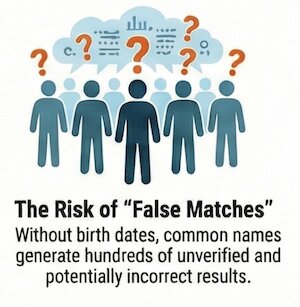
Accuracy Takes Time
Additional verification steps take time. Those are known variables that KRESS builds into our workflow. For others, you may expect South Carolina checks to take an additional two to five business days. In high-volume counties like Charleston, Greenville, and Richland, local demand can increase costs by ten to twenty percent. Together, these policies signal a shift toward stronger privacy protection on public data.
Fair Credit Reporting Act (FCRA) Risks
The Fair Credit Reporting Act requires background screening companies to follow "reasonable procedures" to ensure maximum possible accuracy. That obligation becomes more complex when key identifiers are missing from online search results.
Under FCRA Section 613, screening companies can follow one of two paths before reporting public record data:
- Section 613(a): Send automatic notices to candidates when a record might affect employment.
- Section 613(b): Verify the record manually before reporting it.
Many providers follow the 613(a) path. When identifying data disappears, that path produces more notices, more disputes, and more burden on the candidate to correct the record.
Chandra explains what happens with 613(a) vendors when identifiers disappear: "When identifying data disappears, 613(a) vendors keep reporting the close-match records and sending corresponding notices to candidates, even as the number of those matches grows dramatically. The burden shifts to the candidate to stand up for what is correct on their report. It also increases the chance of a non-hire for false reasons, and puts more burden on the HR or hiring manager to sort through the noise and identify what is actually accurate."
The result is not a cleaner process. It is more notices, more disputes, more follow-up, and a higher risk that a candidate loses a job opportunity over a record that was never theirs.
KRESS follows the stricter 613(b) method. Every public record is verified by a trained researcher before it appears in your report. If the team cannot confirm the match, it is left out entirely. This protects you from false positives and keeps candidates from being unfairly flagged. For more background, see the article Why KRESS Doesn't Use Automatic 613 Notices.
How KRESS Adapts Under Section 613(b)
At KRESS, we use multiple verification methods to confirm each potential record:
- Cross-referencing the SLED CATCH system, which still provides full dates of birth, to verify identity.
- Dispatching local court runners to review physical records and gather additional identifying details where available.
- Expanding search parameters and pulling data from additional sources, including federal court data from the U.S. District Court for South Carolina.
- Working with preferred vendors like InfoCheck who have quickly adapted their own processes to these changes.
It is worth noting that courthouse visits alone do not always resolve the issue. Many South Carolina courts will not confirm dates of birth even in person. That is why KRESS does not rely on any single method. We layer multiple verification approaches to maintain accuracy.
As Chandra describes the KRESS approach: "We don't stop until we are sure, because that's part of the 613(b) way. It's all about having procedures that ensure accuracy, and we modify our processes to keep the accuracy high." For additional reading on this approach, refer to The Importance of Human Verification in Background Checks.
Side-by-Side Comparison: 613(a) vs. 613(b)
| Practice | 613(a) Companies | KRESS Model |
|---|---|---|
| Reporting | Sends possible matches automatically | Verifies each record before reporting |
| Candidate Impact | Frequent disputes and confusion | Candidates see only confirmed results |
| Employer Value | Unverified data and inconsistent quality | Clear, accurate, and compliant reports |
| Cost | Similar Costs | Similar Costs |
| Risk Level | High | Low |
Our 613 Notices: Who Pays the Price? expands on how weak verification affects both employers and candidates. Investing in thorough verification reduces these risks while keeping your process compliant.
Additional verification steps may delay results slightly, but they remove the uncertainty of automated systems. You get fewer candidate disputes, cleaner reports, and stronger compliance defense if questioned by regulators. Applicants can view more guidance in What to Do If You Get a 613 Notice.
The Broader Privacy Trend
South Carolina is not alone. Several states are moving in the same direction. Pennsylvania's Clean Slate law expands which criminal records can be sealed, and in some cases, it happens automatically. Select felony convictions are eligible to be sealed after 10 years, most misdemeanor convictions are eligible after 7 years. The categories of felony (10 years) and misdemeanor (7 years) offenses eligible for sealing include drug crimes, theft offenses (including retail theft and receiving stolen property), trespass, forgery and fraud crimes, and criminal mischief. Most misdemeanors are also eligible, including DUI, simple assault, disorderly conduct, harassment, and resisting arrest.

Why Choose KRESS
- KRESS uses multiple verification methods, including SLED CATCH cross-referencing, court runners, expanded searches, and additional data sources. If a record cannot be confirmed to your applicant, it does not appear in your report.
- KRESS follows Section 613(b): every public record is verified by a trained researcher before it reaches your report. Unconfirmed records are excluded, not flagged and forwarded.
- Our customer service team is based in Houston. You reach a named person, not a ticket queue.
Ready to see how KRESS handles South Carolina's new requirements? Talk to our team today.