






Your background check provider just called a previous employer to verify a candidate. An automated voice asked for employment dates and job titles, and the employer hung up. Most people don't stay on the line for robocalls, and an HR department is no different. What happens next depends on your screening agency, and it is where most of them fall short.

What happens if a background check can't verify employment
Nothing automatic happens if a background check can’t verify employment. “Unable to verify” is a status, not a finding: the background check company couldn’t confirm a job claim with the source that holds the employment records in the time available. It doesn’t mean the candidate lied, and it is not a failed background check.
The employer decides what to do with it. A gap in a background check report doesn’t automatically disqualify anybody, and nothing in federal law says it should. What federal law governs is the process that follows if the employer relies on the background check to say no to a job candidate after a job offer.
What follows is the whole sequence: where automated verification stops working, what the law requires of an employer who acts on an incomplete report, what a candidate can send to close the gap, and what accepting the gap costs. The short version is that an unverified role is a question, and treating it as an answer is where employers get into trouble.
How an unverified role differs from other findings
| Search | What it returns | Can it come back silent? |
|---|---|---|
| Criminal record search | Criminal convictions, or nothing to report | No |
| Credit report, where state law permits one | Credit history | No |
| Motor vehicle records | License status, traffic violations, a suspended license where there is one, and evidence of unsafe driving practices | No |
| Drug screening | A result either way. A failed drug test is a finding rather than a gap | No |
| Employment verification | A confirmation, or silence | Yes |
Criminal history matters where the conduct connects to the job; a candidate's criminal history is not a character score. A failed drug test tells you something. Silence doesn't.
Employment verification is the only line on that list that can return nothing at all, and silence is not evidence. That is why "fail" language sits badly on it. A criminal background check can reveal felony convictions and tell you something. An unverified job has told you only that nobody picked up the phone.
What the background check report shows
A completed employment verification returns employment dates, job title, and, where the employer discloses it, eligibility for rehire and reason for leaving. When the source doesn't respond, the role appears as "unable to verify" alongside the outreach record. The usual reasons are:
- A former employer that never responded
- A paid service gatekeeping the record
- A closure or an acquisition
- Identifiers that didn't match
Read the outreach record on the background check before you read the status: three automated calls to one number is a thin file, and a documented sequence placed at different times is not.
What the employer can and cannot do next
Keep working the item rather than closing the background check early, because the hiring process can carry on and a conditional job offer can stand while the gap is filled. Ask the job candidate for documentation, or verify the roles on either side so the employment history and work history hold together without the missing one.
What you can't do is treat a gap as a finding. If you take adverse action based in whole or in part on the consumer report, the process at 15 U.S.C. § 1681b(b)(3) applies:
- A pre adverse action notice goes first, with a copy of the background check report and the written description of consumer rights.
- A final adverse action notice follows, containing what 15 U.S.C. 1681m(a) requires.
The Fair Credit Reporting Act sets no waiting period between them. Five business days is a convention, not a federal rule, though FTC staff called it reasonable in 1997. Where a criminal record is the basis, some jurisdictions set a floor: California gives the applicant five business days and New York City requires the employer to hold the job open. Some states add stricter rules on top of the federal floor, and some require an individualized assessment before an adverse decision based on a criminal record. Which rules apply depends on where the role sits; see our state-by-state compliance guide. KRESS is a screening agency and not a law firm, so if a decision is close, take legal counsel in the state you're hiring in.
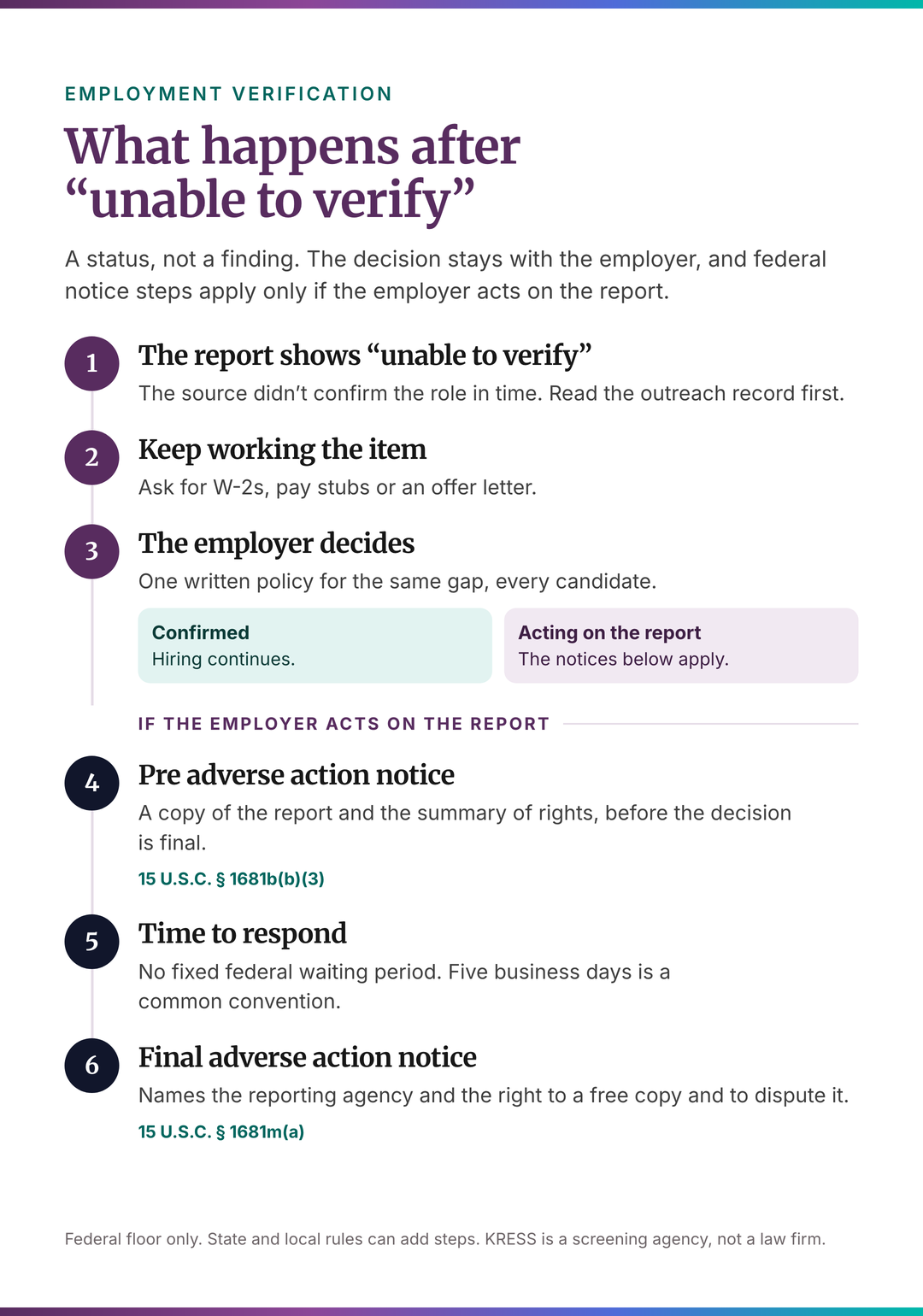
What happens after an “unable to verify” result, and the notices that follow if the employer acts on the report.
What the candidate should do
Ask which former employer and which employment dates the background check couldn't confirm. The employment records that settle it are often ones you already hold:
- W-2s and pay stubs covering the start and end of the role
- Bank statements showing the deposits
- An offer letter, or a letter confirming the role
- A manager's direct line
Tell your future employer in writing that the documentation is on its way, because a future employer that understands the difference usually keeps the role open while the gap is filled. If the report is wrong rather than incomplete, file a dispute so the correct information replaces it. Reinvestigation is free and takes 30 days under 15 U.S.C. 1681i(a)(1).
Why three attempts isn't a verification strategy
Most background check companies run the same standard background screening process: three automated call attempts, a voicemail each time, then a wait. A background check company that stops there hands you the gap, and the background report reaches the hiring manager incomplete. You either accept the background check as it stands or your HR department picks up the phone, and verifying employment yourself defeats the point of paying for it.
Where automated verification runs out
Automated tools resolve the orders they were built for: employers that report payroll data to a verification database and answer through it. Everything outside that, the small business, the closed company, the employer that answers only a written request, needs a person on the phone. Automation is a sensible first step. With no human fallback behind it, every role that sits outside a database is left at risk.
Why automated verification fails
Every background check company depends on information held by another human being, usually someone in an HR department or a small business owner with a dozen other things to do. That is where it breaks down:
- Businesses screen unfamiliar numbers, and an automated call looks like a robocall because it is one.
- Smaller companies have no HR department, so one person holds the employment records and isn't by the phone.
- Large employers route verification through vendors that disclose only employment dates and job titles.
A human can adapt. A dialer can't.
Misrepresentation concentrates where verification is weakest, which is why a job application should never be the only record of a candidate's work history. Employment dates and job titles are the claims a former employer can confirm directly, and that makes them the two claims worth confirming for every candidate.
How KRESS gets to verified
KRESS uses US-based team members who make real phone calls, which is the whole argument for human verification in background checks. When a call to a previous employer doesn't connect, KRESS keeps working the verification at different times, through different contacts, and by email and fax. The goal is a completed verification, not a "we tried" report, because empowering employers to make informed decisions requires one. What employers implement alongside it matters too: built in compliance tools that run the adverse action process on a documented clock stop a decision being finalized while a dispute is open.
> "Verification isn't a data problem, it's a people problem. When our team picks up the phone, we're not running a script, we're having a real conversation with someone at a former employer, and we keep going until we get a real answer. That's what 'verified' is supposed to mean."
Constance Brackett, Chief of Operations, KRESS
What gets verified

A standard KRESS employment verification confirms:
- Employment dates, catching gaps and overlaps in the job history
- Job title, because title inflation is a common form of resume fraud
- Eligibility for rehire, which signals performance issues a criminal background check never shows a hiring manager
- Reason for leaving, where the employer discloses it
For companies that need deeper verification, ResumeMatch cross-references resume claims against primary source data and flags discrepancies between what the candidate submitted and what verification confirms.
When the verification fee gets expensive
A growing number of former employers, and many universities holding education history, have outsourced verification to paid platforms charging $60 to $140 or more per check. DocuProof is built for that: the candidate gets a secure candidate portal link and uploads employment documentation, employment contracts, diplomas or transcripts directly. Clients typically save 70 to 85% against third-party fees, and across roughly 3,000 DocuProof verifications last year saved more than $300,000. Cost is never the reason a candidate's history goes unchecked.
The cost of incomplete verification
When a background check comes back incomplete, the risk transfers into the rest of the hiring process and into every later hiring decision. SHRM puts the cost of replacing an employee at 50 to 200% of annual salary, depending on the level of the role. If an employee causes harm and the background check had gaps you could have filled, that gap becomes a negligent hiring argument.
Under the Fair Credit Reporting Act, agencies must follow "reasonable procedures to assure maximum possible accuracy". An "unverifiable" on a background check after three unanswered calls is harder to defend under that standard than one backed by documented human outreach.
Fair hiring: the same gap, the same treatment, every time
If an unverified job holds one candidate's file open and is waved through on another, you have created a difference you would have to explain. The Equal Employment Opportunity Commission's interest is whether criteria are applied evenly, and a company's background check policy setting out how an unverified role is handled makes even application provable. Nothing should automatically disqualify a candidate before a hiring manager has looked at it. Write the policy down first, meet the legal requirements the same way each time, and fairly assess what the candidate sends back.
Four questions to ask your provider
- How do you contact previous employers? If the answer is automated calling, ask what happens when it fails.
- How many attempts do you make? If three, ask what follows. "Unable to verify" is an admission that they stopped.
- Who is making the calls? If the answer is "our system", they are automated. Real people get better results.
- What is the escalation path when an employer doesn't respond first time?
Common questions about unverifiable employment history
What happens if a background check can't verify employment? The role is reported as unconfirmed and the hiring decision passes to the employer. There is no automatic consequence: you can extend the timeline, accept documentary proof, or verify the roles either side.
What does "unable to verify" mean? The background check company contacted the source and couldn't get a confirmation in time. A well-run background screening report states the reason and shows the outreach attempted, so you can judge whether the file was worked or simply closed.
What should I do if my background check couldn't verify my employment? Provide proof: W-2s, pay stubs, an offer letter, or a manager's direct line. Tell your prospective employer documentation is coming, because a future employer treats an open background check very differently from one closed against you.
Is "unable to verify" the same as a failed background check? No. There is no failed background check status on a background check report. A failed background check, as people use the phrase, means the employer applied its own criteria and said no, and at that point it owes the candidate the notices federal law requires.
What happens if employment verification fails after a job offer? A conditional job offer stays conditional until the background check is complete. If the employer withdraws the job offer, the full adverse action process applies, including the final notice. That withdrawn offer is what most candidates mean by a failed background check. Both notices are covered in our guide to informing a candidate they failed their background check.
What if a past employer has closed or been acquired? Records usually survive the company, sitting with the acquirer's payroll function, a payroll processor, or the former owner. A background check company that works the file can often find the successor record.
How is self employment verified on a background check? Through documentary evidence: a Schedule C or 1099s, business registration, and client confirmations. Say so at the outset rather than letting the role come back unverified.
Will a gap in my employment history cause a problem? Not on its own. Verification confirms the roles you listed, so time studying, caregiving or job hunting has nothing to verify against. Problems come from contradictions: dates that overlap two full-time roles, or a job title the employer won't confirm.
What about jobs I held overseas? They can be verified, but time zones, language and country data protection rules add steps, and some employers will only answer a written request with signed consent attached. Expect longer, and lean on documents you can supply yourself.
How long does verification take? KRESS returns most reports within 24 hours. Employment verification is the piece most likely to run longer, because it depends on someone else answering, and that is the usual reason a background check is still open days after the rest of the file closed.
Can I use pay stubs or W-2s as proof of employment? Usually. W-2s and pay stubs are accepted by most providers, though the list varies, so ask yours.
Can an employer reject me because one role couldn't be verified? An employer may weigh an incomplete employment history in its hiring decision. What the law governs is the process: a pre adverse action notice with a copy of the report under 15 U.S.C. § 1681b(b)(3), then a final adverse action notice under 15 U.S.C. 1681m(a). That pause exists so you can provide context, so send specific evidence and any additional context that supports your version.
What can employers implement to reduce unverifiable results? Choose a provider that escalates to human outreach instead of stopping after a fixed number of attempts, and give candidates a documented route to supply proof.
Stop accepting "unable to verify"
KRESS uses US-based team members for every background check verification. No robocalls. No three-attempt limits. Every role that comes back unconfirmed is a hiring decision you make on less than you paid for. Talk to KRESS, and we'll show you where your background screening process is leaking.